As an Amazon Associate, we earn from qualifying purchases. Some links on this site are affiliate links at no extra cost to you. Our recommendations are based on thorough research and editorial judgment.


Safe Charging Routines for MacBook Longevity

To extend our MacBook’s battery lifespan, we should follow a few simple routines. We can keep the charge between 20% and 80% and avoid letting it drop below 70% frequently. It’s also smart to avoid complete discharges during intensive tasks, as these can wear the battery down. Monitoring battery health through Mac settings helps us manage usage efficiently. Ultimately, using charge limiters like AlDente can offer added control. Let’s explore more strategies to help our devices thrive.
Key Takeaways
- Maintain battery levels between 20% and 80% to reduce stress and prolong the battery lifespan.
- Charge your MacBook before it drops below 70% to avoid deep discharge issues.
- Unplug the device once it reaches a full charge to prevent prolonged time at 100%.
- Regularly recalibrate the battery by discharging to around 40% and then recharging every few weeks.
- Utilize charge limiters to set a maximum charge of 60-80% for enhanced battery health.
Understanding Battery Health and Longevity
You may be interested



Maintaining our MacBook’s battery health is essential for maximizing its lifespan. To effectively manage battery health, we should consider several key points:
- Charge Level: Keep the battery charge between 20% and 80%. This prevents extreme aging and promotes longevity.
- Battery Cycles: Mac notebooks can withstand roughly 1000 charge cycles, retaining about 80% of their capacity after that.
- Optimized Battery Charging: Utilize this feature to learn our charging routine, minimizing the time our Mac stays fully charged.
- Temperature Awareness: Avoid high temperatures—ideal conditions range from 10°C to 35°C (50°F to 95°F) to prevent irreversible damage.
- Calibration: Regularly calibrate the battery every few months to guarantee accurate health readings and energy distribution.
Consider using external accessories like high-quality USB document cameras sparingly when connected, since additional peripherals can slightly increase heat and power draw.
Optimal Charging Habits for Daily Use

To achieve ideal battery health in our MacBook during daily use, we should adopt some straightforward charging habits.
- Maintain Battery Levels: Keep your battery level between 20% and 80%. This reduces stress and prolongs battery aging.
- Charge Smartly: We should connect our MacBook to charge when it falls below 70% and disconnect it once it reaches 80%.
- Avoid Constant Charging: It’s important not to leave our MacBook plugged in continuously, especially when it’s fully charged.
- Weekly Cycle: Ideally, we should allow the battery to drain to around 40% before recharging, supporting effective health management in Mac.
High-wattage adapters often include built-in safeguards that protect against overheating and over-current during fast charging.
Avoiding Complete Discharges

While we might think that letting our MacBook’s battery run completely out is harmless, experts advise against it. Allowing our battery to discharge to 0% can create deep discharge states, requiring longer charging times to restore functionality. Instead, we should aim to keep our battery charged between 20% and 80% for ideal battery health.
Here are some quick tips for avoiding complete discharges:
- Charge before dropping below 70% to maintain health.
- Lithium-ion batteries are designed for partial cycling and don’t need full discharges.
- Using our MacBook while plugged in can improve battery management and prevent deep discharge issues.
Additionally, using accessories like a reliable USB-C to Ethernet adapter with good power delivery can help maintain stable power while plugged in.
Charging During Power-Intensive Tasks

When using our MacBook for power-intensive tasks, such as video editing or gaming, it’s beneficial to charge the device actively. Here are some practical tips:
- Charge Actively: Aim to connect to a power source when the battery level drops below 70-80% to guarantee ideal battery management.
- Avoid Complete Discharges: Letting the battery run low during intensive tasks can increase wear on the battery, reducing its lifespan.
- Consistent Performance: Keeping the MacBook plugged in during demanding activities helps maintain maximum battery efficiency and prevents thermal throttling.
- Proper Cooling: Using a cooling pad can mitigate overheating, supporting safe charging routines.
- Choose durable accessories such as high-quality clear acrylic organizers to keep charging cables and adapters tidy and protected.
Recommended Products

Ultra-Portable: Slim, portable, and light weight allowing you to protect your investment wherever you go

Whisper-Quiet Operation: Enjoy a noise-free and interference-free environment with super quiet fans, allowing you to focus on your work or entertainment without distractions.

👍【Triple Efficient Fans】TECKNET laptop cooling pad with 3 powerful fans works at 1200 RPM to pull in cool air from the bottom to prevent your laptop, notebook, netbook, Ultrabook, Apple MacBook Pro cool from overheating during extended use or intense gaming.
Utilizing Macos Battery Management Features

Utilizing macOS battery management features can considerably enhance our MacBook’s performance and longevity. Apple has incorporated adaptive charging, which learns our usage patterns and can limit charging to around 80% when plugged in for long periods. This helps to reduce battery aging and improves overall battery health.
Key strategies include:
- Charge Level Maintenance: Aim to keep our battery charge level between 20% and 80%.
- Dynamic Charging: macOS enables fast charging to 80%, then uses trickle charging to minimize heat.
- Periodic Calibration: Every few months, we should calibrate our battery for accurate health readings.
Battery replacements and compatible Li-ion batteries can also restore peak performance when an aged battery no longer holds sufficient charge.
Recommended Products
![Techowl A1322 A1278 Battery for MacBook Pro 13 inch Mid 2012 2010 2009 Early 2011 Late 2011 - Long Lasting [65.7Wh/10.95V]](https://m.media-amazon.com/images/I/41VKy9j6MJL._SL500_.jpg)
Model:A1322 A1278 Battery, Voltage:10.95V, Capacity:65.7Wh,100% brand new from manufacture.
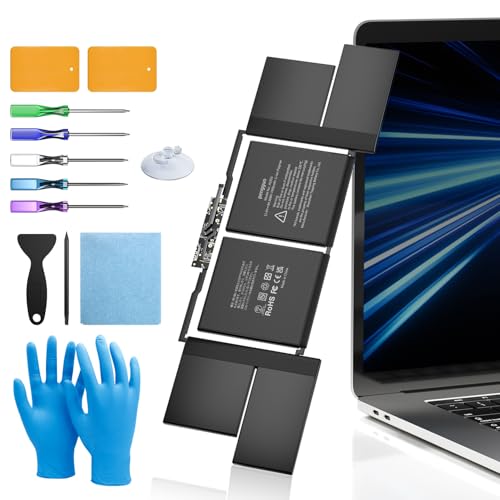
Fits for MacBook pro 15 inch a1990 battery: Battery Model:A1953. Parameter---Capacity: 7400mAh/84.36Wh, Voltage: 11.4V. Battery Type: Li-Polymer
![A1405 Laptop Battery for MacBook Air 13 inch A1466 (Mid 2012,Mid 2013,Early 2014, Early 2015,2017) A1369 (Late 2010, Mid 2011 Version) fits A1496 A1377 [EMC :2925, 2469, 2559, 2392, 2632, 3178]](https://m.media-amazon.com/images/I/41gYu9tEJmL._SL500_.jpg)
A1496 A1405 A1466 A1377 Macbook Air Battery: 51Wh, Voltage: 7.3V, can up to 500 charging cycles; Manufacturing standard are the same as those of the original battery supplier
Monitoring Battery Health Regularly
Monitoring our MacBook’s battery health regularly is essential for ensuring peak performance and longevity. By accessing the Battery settings through the Apple menu, we can keep an eye on the current condition and charge cycles. Here are some key points to remember:
- Battery Health Indicator: Check for recommendations on servicing when performance drops.
- Usage Pattern Analysis: Review battery usage history for the last 24 hours and the past 10 days to refine our power management strategies.
- Optimized Battery Charging: Use this feature to adapt charging patterns to our specific battery needs, enhancing its lifespan.
We should assess battery health at least every few months. By doing this, we help maintain the efficiency of our Apple devices and prolong their battery life. Pop filters like the double-layer designs used in many microphones help reduce sudden pressure spikes, a useful analogy when thinking about protecting battery health during charging.
Recommended Products

Portable Monitor for Laptops: Cocopar laptop screen extender is the ideal portable monitor for Macbook, Surface Pro, Surface Laptop, Lenovo Laptop, HP Laptop, Dell Laptop, ASUS Laptop, etc. This second monitor for laptop supports Extend and Mirror Mode, bringing you efficiency for meetings, work from home, and presentations

【Portable Screen for Laptop】1080P portable laptop monitor is made of reliable IPS A+ screen. Contrast ratio upgraded to 1200:1. With HDR and low blue light technology, it brings you more vivid images. Ultra-thin and lightweight, with a size of 13.9x8.7x0.25 inches and weighing only 1.5 pounds, it can be easily put into a backpack and used anywhere(Without bag)

18.5-inch Large Screen, Lightweight: Equipped with an 18.5-inch 1080p FHD IPS large screen, the VisionOwl portable gaming monitor was designed to create a larger viewing experience. Weighing only 2.7 Lb, 0.24-inch in minimum thickness, and 0.55-inch in maximum thickness, the VisionOwl portable monitor can also be easily carried for travel, work, or relocation
Safe Charging Practices for Extended Storage
To guarantee our MacBook remains in ideal condition during extended storage, it’s crucial to follow specific charging practices. Here’s how we can manage the battery effectively:
- Charge to Approximately 50%: Before storing, confirm the battery is charged to about 50%. This helps prevent deep discharge issues that could lead to battery failure.
- Disconnect the Power: Always disconnect the MacBook from the power source and turn it off during long-term storage. This halts battery usage and preserves battery health.
- Monitor Storage Time: If stored for more than six months, recharge it to around 50% again to maintain its condition.
- Reviving After Storage: When we’re ready to use the MacBook again, allow 20 minutes of charging to boost battery power before booting it up.
For added convenience during charging or monitoring, consider using a device with real-time monitoring to hear immediate audio feedback (useful if you also record or stream while charging).
Managing Temperature for Battery Preservation
When it comes to preserving our MacBook’s battery, managing temperature plays an essential role. Keeping our MacBook within an ideal ambient temperature of 32°F to 95°F (0°C to 35°C) is vital for maintaining battery health. Exposure to heat above 95°F (35°C) can accelerate battery aging and result in irreversible damage.
Here are some key practices for effective temperature management:
- Store in a cool environment: Avoid moisture and high temperatures during inactivity.
- Charge wisely: Use the power adapter in recommended temperatures of 50°F to 95°F (10°C to 35°C) to prevent excessive heat during charging.
- Remove cases: They’re beneficial but can trap heat, negatively impacting battery performance.
Consider using a lightweight, breathable protective case to balance device protection and airflow, especially when transporting your MacBook in warm conditions where waterproof materials can help protect from moisture.
Recommended Charging Routines for Long-Term Use
Establishing a recommended charging routine can greatly enhance our MacBook’s battery life and performance. To maintain ideal health, we should aim to keep our battery charge between 20% and 80%. Here are a few key practices to follow:
- Charge our MacBook when the battery falls below 70% to prevent deep discharge, which harms battery longevity.
- Unplug the device after it reaches a full charge, as staying at 100% for prolonged periods can stress the battery.
- Every couple of weeks, let the battery discharge to around 40% to maintain calibration and efficiency.
- Avoid frequent overnight charging by shutting down or using the battery, as this helps prevent strain on the battery management system.
These routines guarantee our MacBook operates efficiently over time. Using an external power bank with fast charging can help maintain usable battery levels during travel without relying on prolonged charging periods.
Recommended Products

[Massive 50000mAh Power Bank] : Go days without searching for an outlet. This ultra-high-capacity 50000mAh power bank provides steady power for your phones, tablets, and laptops running through road trips, camping, or emergency backup. The smart LED display shows the exact battery percentage—so you always know when it’s time to recharge. No more anxiety about low battery when you need it most.(IMPORTANT: 50000MAH PORTABLE CHARGER ARE NOT ALLOWED ON AIRPLANE)

Ultra-Fast 145W Charging: With PD3.1 and QC3.0, deliver a total of 145W fast charging. A single USB-C1 port provides up to 140W, powering a 16" MacBook Pro from 0-56% in just 30 minutes

300W Total Output Power: Offers 300W max output across two USB-C and one USB-A port, keeping two MacBook Pros running at full speed.
Benefits of Limiting Maximum Charge
Limiting the maximum charge of our MacBook offers several benefits that contribute to overall battery health. By setting a cap of around 60-80%, we can notably extend battery lifespan. Here’s how:
- Reduced Stress: This approach minimizes stress on battery cells, decreasing the frequency of full charge cycles.
- Lower Heat Generation: Batteries charged to Full Capacity tend to generate more heat, accelerating battery aging.
- Better Management: Limiting charge levels helps the battery management software adapt to our usage patterns, leading to smoother performance.
- Enhanced Trade-in Value: A healthier battery means we achieve better trade-in values when upgrading.
Additionally, using power strips with surge protection rated between 900 to 2700 Joules can help protect chargers and devices from electrical spikes, further supporting battery longevity by preventing damage to charging electronics and intermittent heating effects from power surges surge protection.
Third-Party Solutions for Charge Limiting
As we seek to optimize our MacBook’s battery health, turning to third-party solutions for charge limiting can be an effective choice. One notable application is AlDente, which allows us to set specific charge limits, typically around 80%. This helps prevent overcharging and promotes battery longevity.
Here are some key features to evaluate:
- Charge Limits: AlDente’s free version offers basic charge limiting, while the paid version provides more control.
- Flexibility: Some apps let us pause charging entirely, giving us manual control over battery levels.
- Monitoring Options: These tools offer insights into battery health and usage metrics, helping us make informed maintenance decisions.
Many users report improved battery performance when utilizing these charge limiters compared to relying solely on built-in features.
Recommended Products
![A1405 A1466 Laptop Battery for MacBook Air 13 inch A1466 (Mid 2012,Mid 2013,Early 2014, Early 2015,2017) A1369(Late 2010,Mid 2011 Version) fits A1496 A1377 (EMC :2925, 2469, 2559, 2392) [Upgraded 3.0]](https://m.media-amazon.com/images/I/410kDWGDXqL._SL500_.jpg)
Battery: 55Wh, Voltage: 7.6V, can up to 500 charging cycles;

Battery type:Li-ploymer; Capacity: 59Wh; Voltage:10.8V; Cell:6 Cells ;Model:A1185 A1181
![JIONR New A1185 A1181 Laptop Battery for Apple MacBook 13 A1185 A1181 MA561 MA561FE/A MA561G/A MA254 MA255 MB402 MA566 MA561J/A [10.8V 59Wh Black]](https://m.media-amazon.com/images/I/31a5rNXBeWL._SL500_.jpg)
Battery type: Lithium Polymer. Voltage:11.1V Capacity: 59Wh Cell:6 Cells recharge cycles: 500. The battery is durable and has overcurrent protection, anti-overcharge, anti-overdischarge and temperature control functions.
Frequently Asked Questions
How to Make a Macbook Charge Last Longer?
To make our MacBook charge last longer, we should embrace battery health tips, practice ideal charging, avoid overnight charging risks, manage temperature effects, use battery saver modes, and steer clear of full drains.
At What Percentage Should I Charge My Mac?
We should aim to charge our MacBook between 20% and 80% for ideal battery health. Let’s be aware of temperature effects, fast charging impacts, and avoid overnight charging to maintain good cycling habits and reduce cycle counts.
How Many Charge Cycles Should a Macbook Pro Battery Last?
A MacBook Pro battery typically lasts around 1000 charge cycle limits. By monitoring battery health, adopting ideal charging practices, and considering usage patterns, we can guarantee timely replacement indications and enhance overall longevity with energy-saving settings.
Is It Better to Charge a Macbook to 80%?
We’ve learned that charging our MacBook to 80% is like nurturing a plant; ideal care leads to health. By adjusting our charging habits, we can boost battery health and power management, ensuring long-term storage benefits.


